Peruvian Pisco Sour: Egg White Foam and Bitters Technique
Beverage
|
March 17, 2026
Peruvian Pisco Sour is a craft that rewards patience and attention to detail. Whether you are a curious beginner or an experienced cook looking to refine your technique, understanding the fundamentals transforms ordinary ingredients into something remarkable. The journey from raw materials to finished dish involves specific steps that, once mastered, become second nature.
Selecting the Right Pisco
Pisco is a grape brandy produced in Peru and Chile, and the Peruvian style is what is used in the authentic pisco sour. Peruvian pisco is distilled to proof and not aged in wood; it is clear and bottled at between 38 and 48 percent ABV. There are three main types: puro, made from a single grape variety; acholado, a blend of multiple varieties; and mosto verde, distilled from partially fermented grape must.
For a classic pisco sour, I prefer an acholado pisco, which offers a balance of floral and fruity notes that complement the lime juice. I keep the pisco in the freezer, which makes it thick and syrupy when poured and helps the egg white foam set more quickly. The standard pour is 60 milliliters of pisco per drink.
The Dry Shake for Egg White Foam
The egg white foam in a pisco sour is created through a technique called the dry shake. I add 30 milliliters of fresh lime juice, 20 milliliters of simple syrup at a 1:1 ratio, 60 milliliters of pisco, and the white of one egg to a cocktail shaker. First, I shake the mixture without ice for about 15 seconds, vigorously and rapidly. This dry shake incorporates air into the egg white and begins to create a foam matrix.
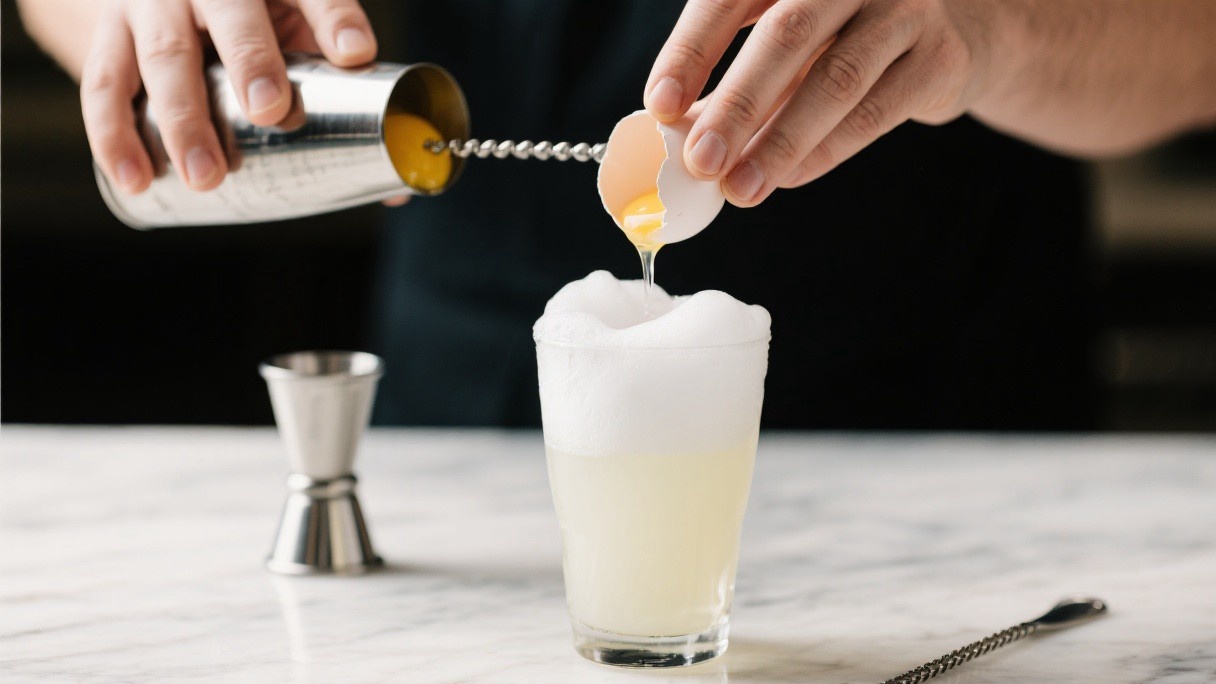
Then I open the shaker, add ice to the top, and shake again for another 15 seconds. This second shake, called the wet shake, chills and dilutes the drink while further refining the foam. Skipping the dry shake produces a thin, bubbly foam rather than the dense, meringue-like cap that defines a proper pisco sour.
Simple Syrup Ratio and Lime Juice Freshness
The balance between sweet and sour in a pisco sour follows a ratio of 3 parts pisco to 2 parts lime juice to 1.5 parts simple syrup. For a single drink, that is 60 milliliters of pisco, 40 milliliters of lime juice, and 30 milliliters of simple syrup. I use freshly squeezed lime juice, strained to remove pulp, and I squeeze the limes no more than 30 minutes before mixing.
Lime juice loses its bright, aromatic quality quickly after squeezing, and the flavor shifts from sharp and clean to flat and dull. The simple syrup should be made with white sugar at a 1:1 ratio by weight, which produces a neutral sweetness that does not compete with the pisco. Some bartenders use a richer 2:1 syrup, which I find makes the drink too sweet and masks the floral qualities of the pisco.
The Bitters Pattern and Presentation
After straining the pisco sour into a chilled coupe glass, I add Angostura bitters to the surface of the foam. The traditional pattern is 3 drops arranged in a triangle, or 6 drops arranged in two rows of three. I hold the bottle of bitters about 5 centimeters above the foam and tap it gently to release individual drops.
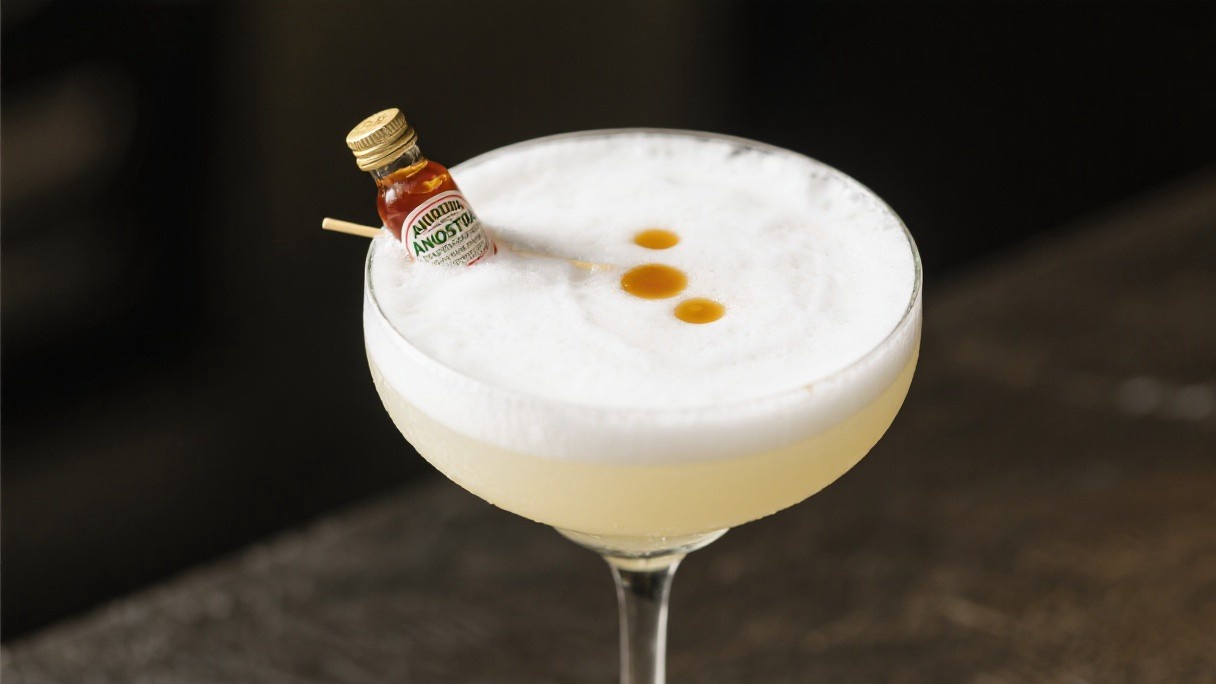
The bitters serve two purposes: they add a subtle aromatic complexity that contrasts with the sweet-tart body of the drink, and they create a visual pattern on the white foam that makes the drink immediately recognizable. Some bartenders draw lines or dots with a toothpick through the drops to create more elaborate designs, but I prefer the simplicity of evenly spaced drops.
Pitfalls to Watch For
The most frequent error I see is using old egg whites. Fresh egg whites produce a more stable, denser foam with better volume. I separate the egg white from the yolk carefully, ensuring no yolk contaminates the white, because even a small amount of yolk fat will prevent the foam from forming properly. Another common mistake is over-shaking the wet shake, which over-dilutes the drink and produces a foam that collapses quickly.
I count my shakes rather than estimating time: 20 firm shakes for the dry shake and 20 for the wet shake. Finally, the glass must be chilled before straining; a warm glass causes the foam to begin melting immediately, and the drink loses its textural appeal within seconds of being served.
Troubleshooting Common Fermentation Problems
Several problems can arise during makgeolli fermentation, and most of them are correctable if caught early. If the mash develops a film of white or colored mold on the surface, I scoop it off carefully with a clean spoon. A thin white film is usually kahm yeast, which is harmless, while colored mold indicates contamination and the batch should be discarded.
If the fermentation does not start within 48 hours, the nuruk may be inactive, and I add a pinch of active dry yeast to get it going. If the finished makgeolli is too sour, I add a small amount of sugar or honey before serving. If it is too thin and lacks body, I reduce the water-to-rice ratio in the next batch by 10 percent.
Keeping detailed notes on each batch, including the nuruk source, fermentation temperature, and tasting observations, has helped me refine my process over successive batches.
A well-made pisco sour is one of the most elegant cocktails you can serve, and the technique is surprisingly approachable once you understand the role of each ingredient. Chill your glasses ahead of time, use the freshest lime juice available, and practice your dry shake until the foam reaches that silky, meringue-like consistency.