Belgian Waffles: Yeast vs Liege Style with Pearl Sugar
Dessert
|
March 20, 2026
When people refer to Belgian waffles, they are usually thinking of one of two distinct styles: the Brussels waffle, which is light, crisp, and rectangular with deep pockets, and the Liege waffle, which is denser, sweeter, and studded with chunks of caramelized pearl sugar. I have made both styles extensively, and they are fundamentally different pastries that require different techniques and produce entirely different eating experiences.
The Brussels waffle is a breakfast item served with toppings, while the Liege waffle is a street food, meant to be eaten plain, warm from the iron, with no accompaniment needed.
Brussels Waffle: Yeast-Leavened Batter
The Brussels waffle batter is yeast-leavened, which gives it a light, airy interior and a crisp exterior. I dissolve 7 grams of active dry yeast in 125 milliliters of warm milk, about 37 degrees Celsius, and let it sit for 5 minutes until foamy. In a separate bowl, I whisk together 250 grams of all-purpose flour, 30 grams of sugar, half a teaspoon of salt, and 1 teaspoon of vanilla extract.
I add the yeast mixture, 2 separated egg yolks, and 75 grams of melted, cooled butter, stirring until a smooth batter forms. I whip the 2 egg whites to stiff peaks and fold them into the batter in two additions. The batter rests at room temperature for 1 hour, during which it doubles in volume and becomes bubbly.
I cook the waffles in a preheated waffle iron set to medium-high heat, using about 150 milliliters of batter per waffle, for 4 to 5 minutes until deep golden brown.
Liege Waffle: Brioche-Style Dough
The Liege waffle is made from a dough rather than a batter, and its texture is closer to a brioche than to a pancake. I combine 375 grams of bread flour, 7 grams of instant yeast, 50 grams of sugar, and half a teaspoon of salt in the bowl of a stand mixer.
I add 1 egg, 125 milliliters of warm milk, and 75 grams of softened butter, mixing with the dough hook for 8 to 10 minutes until the dough is smooth, elastic, and pulls away from the sides of the bowl. The dough rests, covered, at room temperature for 1 hour until doubled in size.
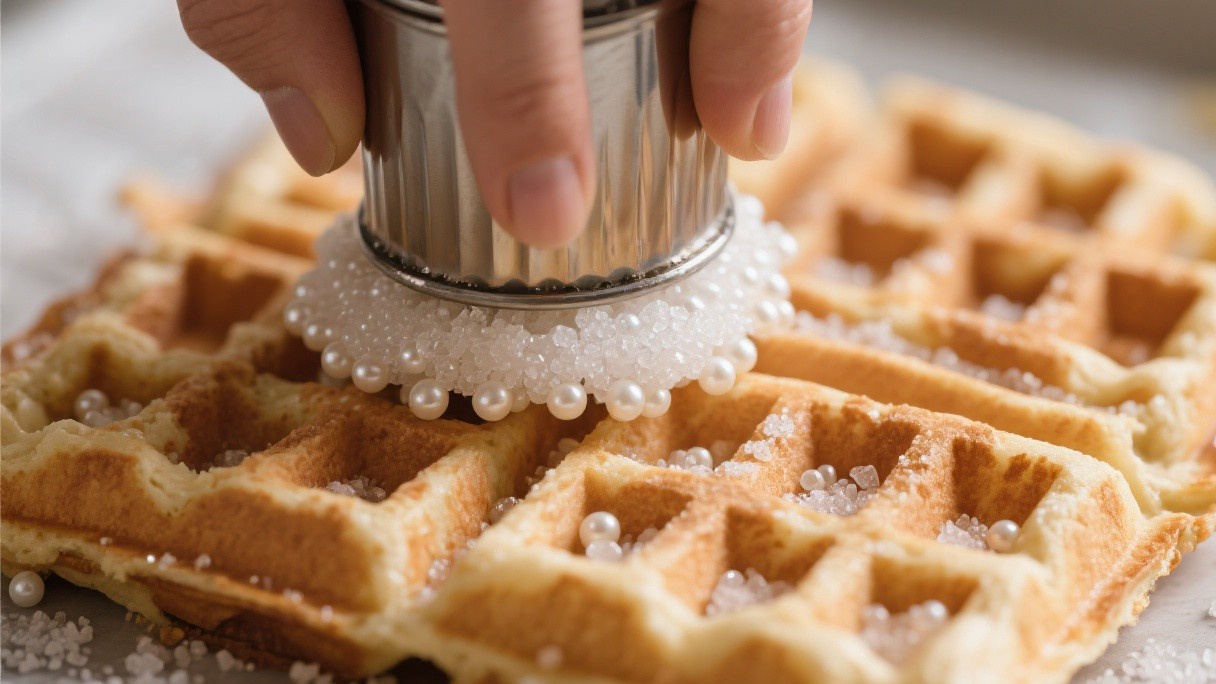
Then I punch it down, add 200 grams of pearl sugar, and fold the sugar into the dough by hand in about 15 to 20 gentle folds. The pearl sugar must not be mixed in with the dough hook, because that would crush the pearls and distribute the sugar too finely.
Pearl Sugar and Its Caramelization
Pearl sugar, also called nib sugar, is made from compressed sugar crystals that are resistant to dissolving. During cooking, the pearls on the exterior of the waffle caramelize without fully melting, creating crunchy, sweet pockets that contrast with the soft dough. I use Belgian pearl sugar, which has larger crystals than the Scandinavian variety and produces more pronounced caramelized chunks.
The sugar is folded into the risen dough gently, and some pearls inevitably break during folding, which is fine; the broken pieces contribute to the overall sweetness of the dough. The intact pearls, which should be visible as white specks throughout the dough, are what create the signature caramelized bites in the finished waffle.
Cooking Temperature and Timing
Liege waffles require a lower cooking temperature and longer time than Brussels waffles. I set my waffle iron to medium heat, which is about 180 degrees Celsius, and cook each waffle for 6 to 8 minutes. The lower temperature gives the pearl sugar time to caramelize slowly without burning, while the longer cooking time ensures that the thick dough cooks through to the center.
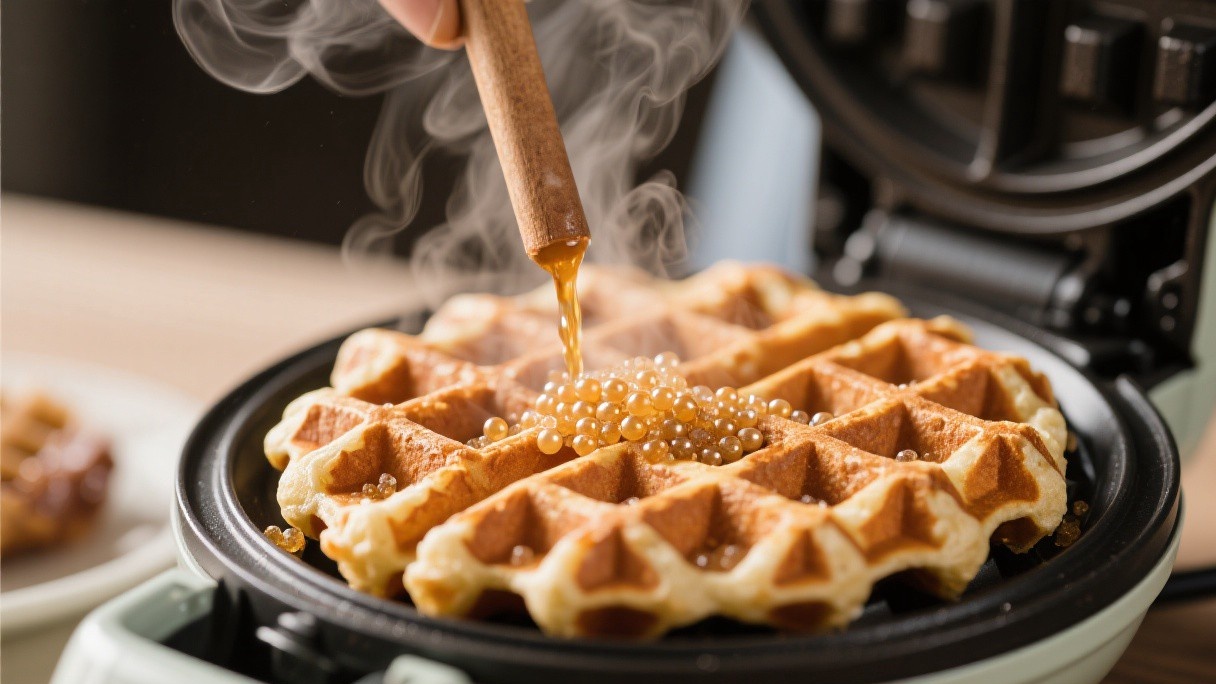
I press the waffle iron firmly to compact the dough, which creates the dense, chewy texture that characterizes the Liege style. The waffle is done when it is deep golden brown with visible patches of caramelized sugar on the surface. I remove it from the iron and let it rest on a wire rack for 2 minutes before eating, which allows the caramelized sugar to set slightly and prevents burning the mouth.
Serving and Topping Choices
Brussels waffles are served with toppings: butter and maple syrup, fresh berries and whipped cream, or chocolate sauce and sliced bananas. The deep pockets hold the toppings effectively, and the light, crisp texture of the waffle provides a neutral base for whatever flavors are added. Liege waffles, by contrast, are eaten plain or with minimal additions. The pearl sugar provides all the sweetness needed, and the dense, brioche-like texture is satisfying on its own.
I occasionally serve Liege waffles with a thin spread of salted butter, which enhances the caramel notes of the pearl sugar, or with a light dusting of powdered sugar. Both styles are best eaten immediately after cooking, though Brussels waffles can be reheated in a toaster oven at 200 degrees Celsius for 3 minutes to restore their crispness.
Whether you prefer the light, airy texture of yeast-raised waffles or the dense, caramelized sweetness of Liege style, the key is a hot waffle iron and patience. Do not lift the lid too early, and let the exterior develop a deep golden color for the best flavor and crunch.