French Macaron: Italian vs Swiss Meringue Methods Compared
Dessert
|
March 16, 2026
Macarons are among the most technically demanding pastries in the French repertoire, and the choice of meringue method, Italian or Swiss, has a significant impact on the final result. I have produced hundreds of batches using both methods, and each has distinct advantages depending on the environment, the filling, and the level of precision the baker can maintain.
Both methods produce the same basic shell, a crisp exterior with a chewy interior and the characteristic ruffled foot, but they differ in stability, ease of execution, and the texture of the finished macaron.
The Italian Meringue Method
In the Italian method, a sugar syrup heated to 118 degrees Celsius is poured in a thin stream into egg whites that have been whipped to soft peaks. The hot sugar cooks the whites as it incorporates, producing a meringue that is more stable and less prone to deflation.
For a standard batch, I use 150 grams of egg whites, 200 grams of granulated sugar for the syrup, and 200 grams of almond flour sifted together with 200 grams of powdered sugar. The syrup must be at exactly 118 degrees; lower, and the meringue will not be stable enough, higher, and it will set too quickly to incorporate properly.
I pour the syrup slowly while the mixer runs on medium speed, then increase to high and whip until the meringue is thick, glossy, and cooled to about 50 degrees Celsius. This meringue is then folded into the almond-sugar mixture in a process called macaronage.
The Swiss Meringue Method
The Swiss method involves heating egg whites and sugar together over a water bath to 60 degrees Celsius while whisking constantly, then whipping the warm mixture on high speed until stiff, glossy peaks form. I use the same ratio of 150 grams of egg whites to 200 grams of sugar, heating them in a clean bowl set over simmering water.
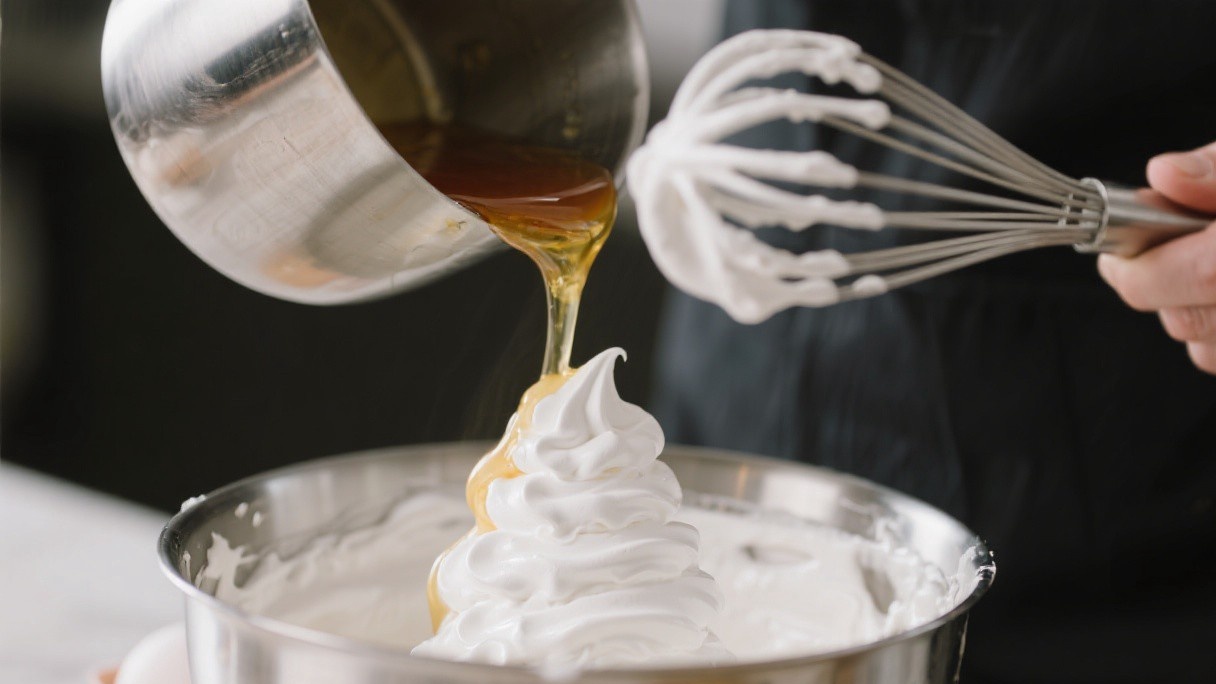
A candy thermometer is essential; the mixture must reach 60 degrees to ensure that the sugar is fully dissolved and the whites are pasteurized. Once at temperature, I transfer the bowl to the mixer and whip on high for about 8 minutes until the meringue is stiff and the bowl is cool to the touch.
Swiss meringue is slightly less stable than Italian meringue but more stable than French, and it produces a macaron shell with a slightly smoother, more matte surface.
Macaronage: The Critical Folding Step
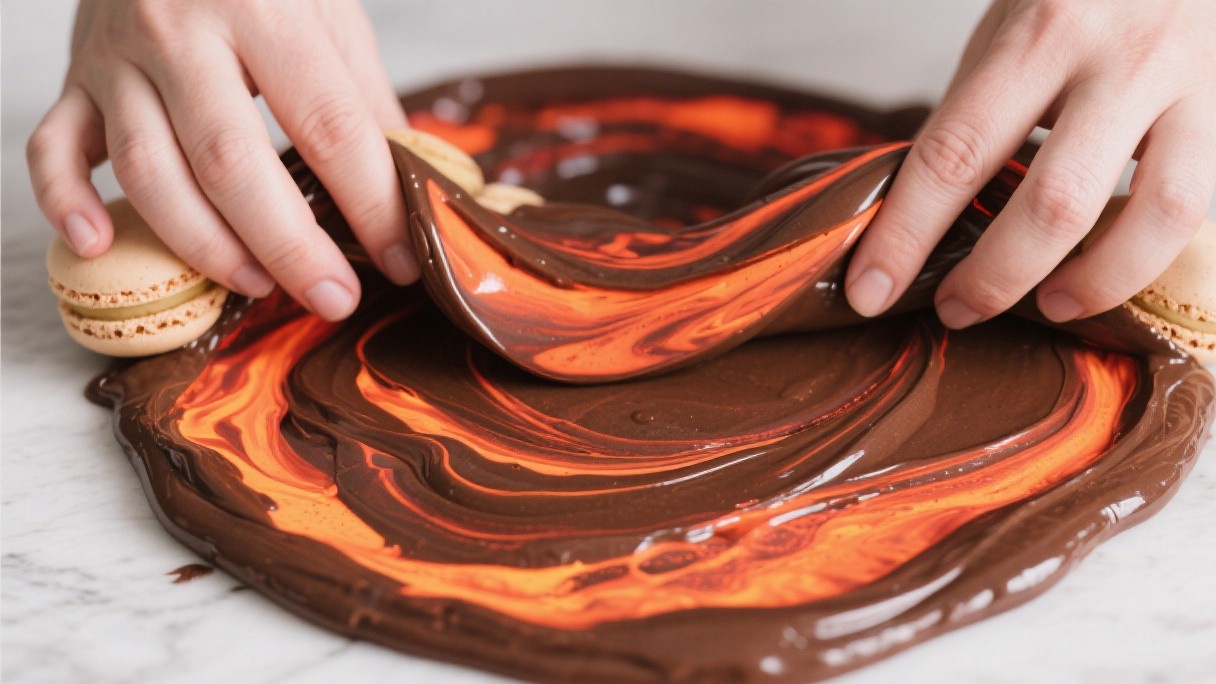
Regardless of the meringue method, the macaronage process is identical. I add the meringue to the sifted almond flour and powdered sugar in three additions, folding each one until combined. The folding motion involves pressing the batter against the side of the bowl with a spatula, then scooping it back up and turning it over.
I continue folding until the batter flows in a thick ribbon from the spatula and the ribbon merges back into the mass within about 20 seconds. Under-mixed batter produces macarons with pointed peaks that do not smooth out; over-mixed batter spreads too thin and produces macarons with no feet.
I pipe the batter onto a sheet pan lined with parchment paper or a silicone mat, holding the piping bag perpendicular to the surface and applying even pressure to form 3.5-centimeter circles.
Resting and Baking Conditions
After piping, I let the macarons rest at room temperature for 30 to 60 minutes until a skin forms on the surface. The skin should be dry to the touch and slightly matte; when I press it gently with my fingertip, it should not stick. This skin is what causes the batter to rise upward during baking rather than spreading outward, which creates the characteristic foot.
I bake at 150 degrees Celsius for 14 to 16 minutes, rotating the pan once at the halfway mark. The macarons are done when they can be lifted cleanly from the parchment and the bottoms are dry. Humidity is the biggest enemy of macaron making; on days with humidity above 60 percent, the resting time may need to extend to 90 minutes, and the shells may still be slightly more fragile than on dry days.
Comparing Results and Choosing a Method
After extensive testing, I reach for the Italian method when I need maximum consistency, — when I am making macarons for an event or as gifts. The Italian meringue is more forgiving of minor errors in macaronage and produces shells with a more pronounced foot and a slightly glossier surface. I use the Swiss method when I want a smoother, more matte finish and when I am working in a kitchen where precise temperature control is easier to maintain.
The Swiss method produces a slightly chewier interior that some people prefer. Both methods benefit from aging the egg whites: I separate the whites 24 to 48 hours in advance and leave them in the refrigerator, covered, which thins them slightly and makes them easier to whip to high volume.
The most important step is the first one. Gather your ingredients, set aside uninterrupted time, and commit to following the process through. Even imperfect results will taste better than anything mass-produced, and the skills you build here carry over to countless other recipes.